Feeds:
Posts
Comments

Undergrads looking for a place to submit your creative writing?

Check out Bowling Green State University’s Prairie Margins and Susquehanna University’s Susquehanna Review.

I just received a nice-looking issue of Susquehanna and an email from Prairie Margins; both are very interested in receiving submissions from undergraduate writers!

NEW LOCAL FESTIVAL KICKS OFF THIS FEB. 13TH
[I served on the selection committee, and there are some great short films! Prepare to be inspired.]

3
Film Festival of Short Films
@ Studio Art Classes
Saturday, February 13, 2010
7:00-9:00 p.m.
Admission: $3
http://three-fest.blogspot.com/

Studio Art Classes is located in Mishawaka (4609 Grape Road, behind the old Barnes and Nobles)


The festival, which received over seventy entries, will kick off its first year with diverse shorts in many genres by local as well as non-local filmmakers from Mexico, Tasmania (Australia), France and Slovenia.  There will be a sampling of music videos, animation shorts, experimental films, documentaries and narrative films by students and professionals, artists and filmmakers.  There will be a whole range of films, from the satirical music video, I’m Sorry Llama by local filmmaker Tim Richardson to a documentary about boys that train spiders to fight each other in Paris.

The $3 admission fee includes a raffle for the audience. Raffled off will be two hour-long massages, donated by Hofferth Chiropractic Center as well as a number of tickets to the Vickers theatre in Three Oaks, Michigan.  The audience will also be given the opportunity to select the top films from among those screened.

The poet Mary Biddinger will give a reading at IU South Bend on Wednesday, March 10 at 7:00. She’ll spend the day visiting several classes.

More info to come, but in the meantime, here’s an interview with Mary: http://howapoemhappens.blogspot.com/2010/02/mary-biddinger.html

Faculty Publications

David Dodd Lee has two poetry collections that will be published this year: The Nervous Filaments will be published by Four Way Press next month, and Orphan, Indiana will be out in October. He also edited the recently published The Other Side:  Selected Poems of Herbert Scott (which looks beautiful!).

He has recently published or has poems forthcoming in Columbia Poetry Review, Verse, Shampoo, Zone 3, Third Coast, Interim, Field (in two different issues), Barn Owl Review, Salamander, Blackbird, and was a runner up for the Mississippi Review prize. Check: Howapoemhappens.blogspot.com for an interview with DDL (to appear in the next couple days).

Clayton Michaels has poems forthcoming in Anti- and Tipton Poetry Journal.

Kelcey Parker’s creative nonfiction piece – “Students Die, and What Is Poetry?” – was accepted by Third Coast for the Fall 2010 issue.

2010 English Department Writing Awards in Honor of Lester M. Wolfson

Rules and Procedures:

Awards:
Prizes in poetry, short fiction, drama, and non-fiction prose. The poetry award is in honor of Lester M. Wolfson, Emeritus Professor of English, who served as chief administrative officer of Indiana University South Bend from 1964 until his retirement as Chancellor in 1987. (Please note that these student awards are different from the new national poetry book prize. Further info on that contest available in the tab above.)

Eligibility:
All Indiana University South Bend students full and part time who are in good standing and who have been enrolled in any academic term during the calendar year of the submission deadline are eligible to enter all genres. Students who have won 1st place in a genre in a previous competition are no longer eligible to enter that genre, but may enter other genres.

Submission Rules:
1.         Submit manuscripts by e-mail to anrichmo@iusb.edu by Monday, February 15, 2010.

2.         Manuscript preparation:

A.  Submit documents as a Word, PDF, or RFT attachment.

B.   Include name, student ID#, and IU South Bend e-mail address on the first page only of each manuscript.

Genre Rules:
Poetry:  1 to 3 poems, maximum of 6 pages
Short Fiction:  1 story, maximum of 5,000 words
Drama:  1 one-act or 1 full-length play (no musicals)
Non-fiction Prose:  1 work of non-fiction, maximum of 5,000 words

Winners will be announced at the ceremony on Saturday, April 10, 2010. This year’s judge and guest speaker is poet Mary Szybist.

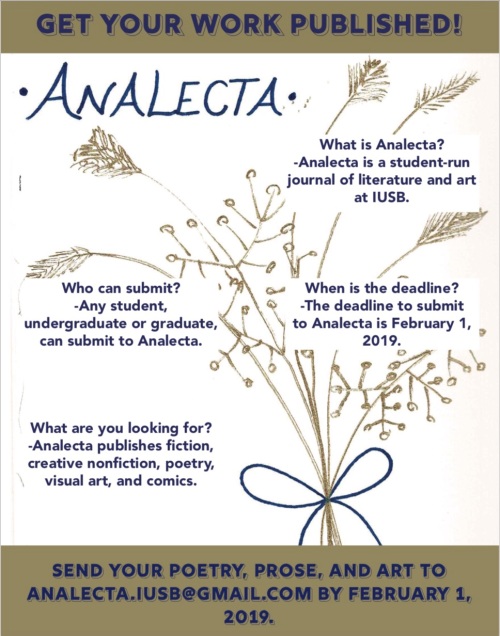
Any manuscripts submitted are automatically considered by the staff of Analecta, IU South Bend’s student-edited and student-written inter-arts magazine, for publication in its annual spring issue.

A NEW SHORT SHORT FILM FESTIVAL

Accepting films until January 18th, 2010!
Any genre!
Up to three minutes long!

http://three-fest.blogspot.com/

CALL FOR SUBMISSIONS!

Whether you are an established or first-time filmmaker, send us your films!
There is no submission fee.
Films will be selected by a juried committee.

Submission Info:
Deadline: 1/18/10

Mail a data DVD/CD to:
Studio Arts
4609 Grape Road
Mishawaka, IN 46545

Please include your contact info; name, phone, email.
All submissions should be 3 minutes in length maximum and in the Quicktime format.
(720 x 480 for 4:3 and 854 x 480 for 16:9)

You may submit up to two entries.

3-FEST Screening Info:
Screening: February 13 2010, 7-9 PM

Studio Arts
4609 Grape Road
Mishawaka, IN 46545

Audience Awards for top films!
Winning films will also be shown on our web page!

Questions? Email us.
three.fest@yahoo.com

Here are some courses still available that might be of interest to creative writers at IUSB this spring. They also count toward a Creative Writing Minor.

ENG-A 190 — Arts, Aesthetics, and Creativity (3 cr.)
4500     MW  1:00-2:15 P
This section is open.
Topic: The Work of Literary Art in the Age of Mechanical Reproduction

These days, if you write the Great American Novel (or think you have), all you have to do to get it published is go to a print-on-demand website, upload the file, and enter your credit card information. Voila!

In this class we will celebrate today’s technologies that make possible, in particular, the rise of personalized publishing, and independent literary presses (such as our own Wolfson Press). We will compose and print multiple copies of chapbooks and a class literary journal to share our writing with others, and we’ll publish work online to reach an even wider audience. But we will also celebrate what Walter Benjamin would call the “aura” of an original art object that cannot be reproduced. Benjamin says, “that which withers in the age of mechanical reproduction is the aura of the work of art…. By making many reproductions it substitutes a plurality of copies for a unique existence.” Thus we will create literary art objects that have a unique existence: altered books, collages, post cards between imagined characters, and handmade (even handwritten!) mini-books filled with our stories, poems, and ponderings.

This is a project-based writing and art-making class that invites students without previous experience to explore artistic practices and concepts, including narrative collage, Pop Art, found texts, altered texts, erasure, and appropriation. We’ll read contemporary poetry and prose, and we’ll read from Walter Benjamin’s 1935 essay that inspired the course’s title.

ENG-W 280 — Literary Editing & Publishing (3 cr.)
30771  T  5:30-6:45P     David Dodd Lee Permission required

This class is designed to educate students by exposing them to contemporary writing as it goes through the process—from mailbox to published book—of being judged and selected for publication.  During class time students will read and critique manuscripts submitted to Wolfson Press for possible publication.  We will focus on the mechanics and ethics inherent in any editorial endeavor that includes selection as part of its process.  (And this process of selection and debate will take place exclusively in the classroom–students will not be allowed to take unpublished manuscripts home, for instance.) Not only will students learn, through examples brought to light by the instructor, how to screen manuscripts based on aesthetic ideas, but they will also be instructed in the nuts and bolts of dealing with manuscripts in a professional and judicious manner.  Additionally, students will learn some fundamentals of publishing including editing, marketing, correspondence with writers and other presses, and principles of layout and design.  Interpersonal skills will be emphasized (as part of the process of disagreement and consensus) as we begin to focus on the aesthetic aspects of contemporary writing through the prism—a cross-section, so to speak—of styles of writing reflected in the submitted manuscripts.  From more theory-driven, avant-garde works to more relatively mainstream works—post-confessional and simple narrative—students will examine the various stances and approaches available to the contemporary writer, as well as the hybridization of genres and styles that is currently part of the literary landscape.

—–

For graduate students, this is not a creative writing class, per se, but is highly recommended for anyone interested in language, representation, and creation.

LBST-D 501 – Humanities Seminar (3 cr.)
Class Number  25971   R 7:00 – 9:30 P   Instructor:  Anne Magnan-Park

[Note: while this course is primarily intended for students in the Master of Liberal Studies program, non-MLS students interested in the topic should consult with the instructor to see whether it might be a good choice for them, too.]

Topic: Translation as Metaphor: An Interdisciplinary Journey

The task of the literary translator is similar in nature to that of the interdisciplinary scholar in that it deals in the delicate business of border crossing. Indeed, the interdisciplinary scholar devises and crosses constructive bridges from one academic discipline to another while the literary translator strives to safely carry the unique voice of a particular author across cultural and linguistic boundaries. The journeys they both undertake require credentials and the mastery of a set of sharpened tools in more than one discipline/culture, as well as the development of a personal philosophy that allow them to make consistent and productive choices in the hope of proposing a credible solution to a complex issue. This course is designed to introduce you to the history, theory, and practice of literary translation and to use that knowledge to investigate the disciplines of literary and film studies. Some of the questions we may ask are: what are the disciplines in which one needs to engage to interpret a literary text or a film, and most specifically a text or film dealing with postcolonial issues? How do writers and filmmakers translate the clash of two specific cultures in their works? To what extent can one say that translators are creators, bridge builders who invent alternative ways of crossing cultural chasms? We will mostly focus on New Zealand culture, literature, and cinema, namely the works of Patricia Grace (“A Way of Talking,” “Parade,” “Butterflies,” among others), Margaret Mahy (“The Bridge Builder”), Alice Tawhai (Festival of Miracles), Peter Jackson (Heavenly Creatures), and Lee Tamahori (Once were Warriors). Other authors and filmmakers will also be considered, such as Indian American fiction writer Jhumpa Lahiri (Interpreter of Maladies), Franco-Chinese poet Francois Cheng (poems), and Moroccan filmmaker Faouzi Bensaidi (La Falaise). The knowledge of a foreign language is not required but the desire to embrace a foreign culture is the secret decoder ring to success for this course!

A message from Analecta’s editor:

Hello,

This is Mitchell Robinson, the editor of IUSB’s annual, award-winning, Literary and Arts magazine, THE ANALECTA.  I wanted to wish everyone happy holidays. More importantly, however, I wanted to remind everyone what a perfect time winter break is to write poetry, short fiction, non-fiction, drama, take pictures, or even paint.

The snow is on the ground, your hot chocolate is steaming, your slippers are warming your feet, and your blanket is keeping you company. The book that you really wanted to read all semester but couldn’t find the time/brainpower to read as you wrote all those papers, is on your coffee table, facedown and open mid-way (for me, it’s The Secret Agent by Joseph Conrad and Miss Lonleyhearts by Nathaniel West.) With the idyllic conditions for your newest masterwork, you turn off the reruns of Scrubs and begin to write. Not papers, responses, nor reflections, but something that is more personal, that moves you, humors you, makes you feel something other than the cold bite on your nose. Or perhaps, the snow on the ground makes you want to add a little color to your break, so you use the acrylic paint or new camera you received for the Holidays.

So write over the break or perfect the work that your wrote over the semester and submit to THE ANALECTA!

Mitchell Robinson

For more information:

-Email Analecta@iusb.edu

-www.iusbcreativewriting.wordpress.com

-Find THE ANALECTA on Facebook!

The latest update from Ryan Sanford Smith, graduate of IU South Bend and MFA student in poetry at Notre Dame:

In my last post I talked about a couple of things I had learned so far in my first term in an MFA program, and now I’d like to get to one of the more troubling things I haven’t quite learned yet—when do we do that writing stuff?

This isn’t to say that I’m not writing, but it is accurate to say that looking back on my workshopped poems over the term now coming to a close, I’m mostly at a loss to recall when I wrote a single one of them.  At a glance the class load seems light, or at least manageable—9 total credit hours per term spread over a workshop, a literature course, and ‘thesis direction’, which is exactly what you might think it is. To be fair, thesis direction in the first time (and well into the second) is generally considered a kind of ‘filler’, as first years don’t tend to even have picked an advisor much less done too much thinking or writing on their creative thesis, which is a book-length volume of poems on the Poetry side of the program.

But time fills in quickly—literature courses at the grad. level are, as expected, fairly taxing. When I think about ‘my writing’, mentally I conjure every hour spent researching and writing academic papers for my lit. class this term, not my poetry. So, time goes. There are meetings with professors, readings and lunches with guest authors, social engagements (your socially-inept correspondent mentions this mostly in a theoretical sense), and everyone has a job of some kind, whether working in some manner for the program, teaching (if any dear IUSB readers know Professor Waterman or Professor Stockdale, they are comrades, so be nice!), and so on.

In speaking with my fellow first years, this all resolves into a question we weren’t expecting to ask: when do we write? Not research papers for lit. courses that feel, to put it nicely, not all that pointedly geared in our direction—but the ‘art’ we came here to have time to work on. The joke of course quickly becomes ‘time management is the art!’ which is sad, funny, and absolutely true.

None of us seems to have it figured out yet, though week after week workshop submissions seem to appear from us, almost magically. Pressure can work wonders, enforcing a sort of discipline artists of all walks aren’t usually known for, and perhaps this is one of the real lessons of an MFA—teaching writers within a kind of meta-lesson how to create and keep the time needed to write when it seems next to impossible to do so.

Photos of Student Art Exhibit

Older Posts »